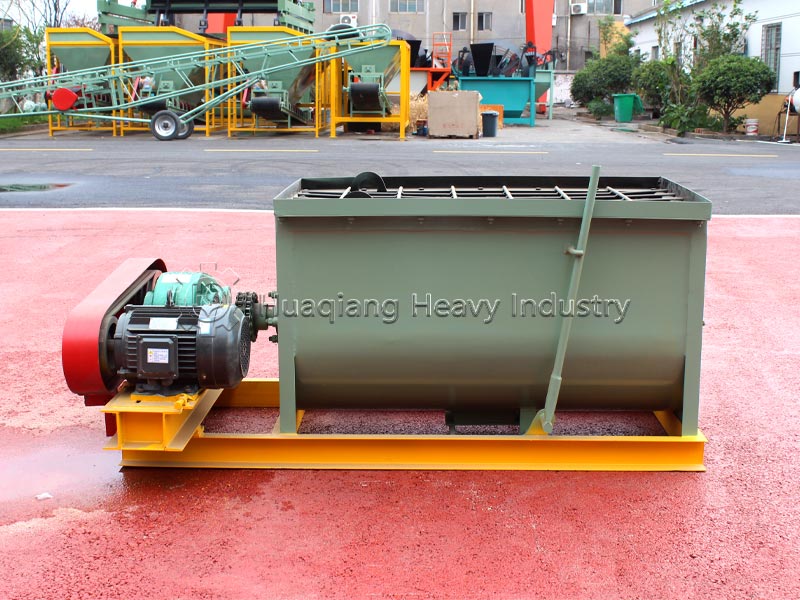
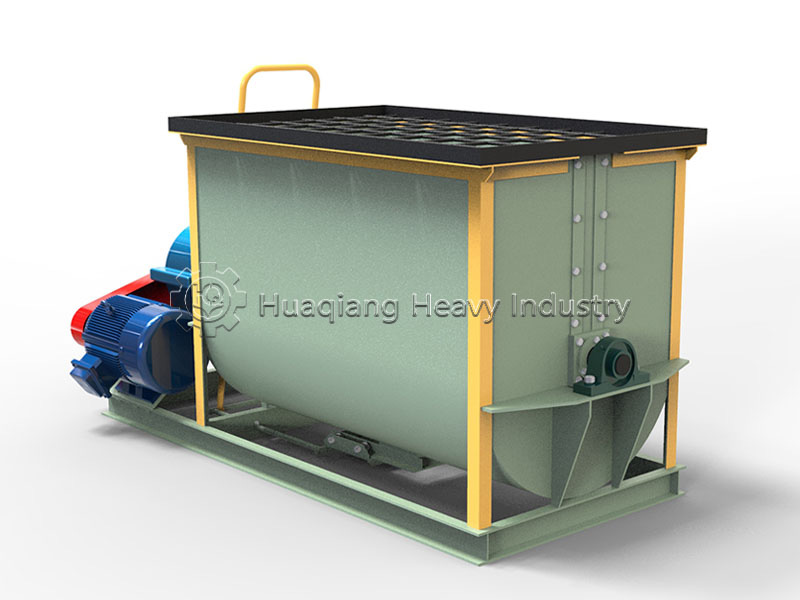
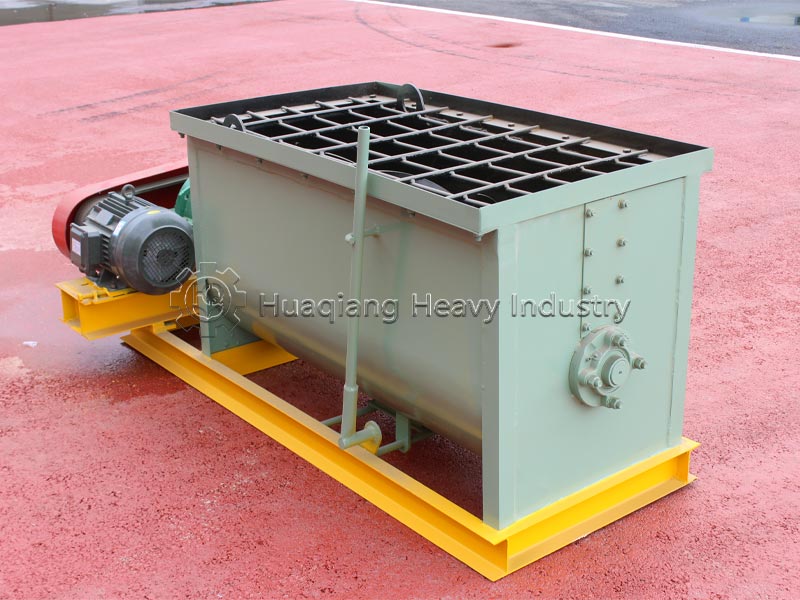
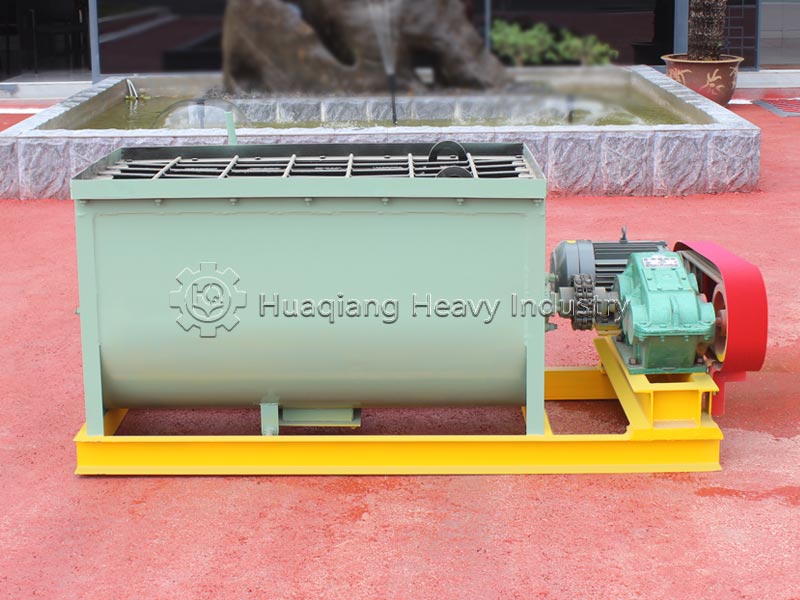
The horizontal mixer (also known as a horizontal ribbon mixer) is a key piece of equipment for mixing industrial powders, granules, and viscous materials. Across industries ranging from chemicals and pharmaceuticals to food processing and construction materials, the dual-layer ribbon rotating within its U-shaped trough handles a wide range of solid-solid and solid-liquid mixing tasks.
The core operating mechanism of the horizontal mixer consists of inner and outer ribbon agitators mounted on a central shaft, with the ribbons wound in opposite directions.
The specific operation is as follows:
Driven by the motor, the outer ribbon—due to its winding configuration and direction of rotation—pushes material from both ends of the U-shaped vessel toward the center, while the inner ribbon pushes material from the center toward the ends, creating intense convective mixing. Simultaneously, the material moves both axially and radially under the action of the ribbons, undergoing shearing, diffusion, and blending to create a three-dimensional flow pattern.
This synergistic action of counter-rotating ribbons generates convective circulation and shear-blending within the vessel. Some models utilize a discontinuous (interrupted) ribbon design; compared to continuous ribbons, this generates greater shear forces and creates more turbulence within the material flow, further accelerating the mixing process and enhancing mixture uniformity.
In terms of efficiency, a horizontal mixer typically completes a mixing cycle in 2 to 5 minutes. Under typical operating conditions, the processing time per batch is approximately 10 to 15 minutes; including loading and unloading times, the machine can process about four batches per hour.
High mixing efficiency: A batch can be mixed in 2–8 minutes, which is significantly faster than vertical mixing equipment.
Excellent mixing uniformity: Uniformity can exceed 99%; for a powder mixing ratio of 1:10,000, the standard deviation can reach 0.00003.
High loading coefficient: The loading volume can reach 60%–75% of the vessel's total volume; actual feed quantities should be controlled within this range.
Clean discharge with minimal residue: The combination of a bottom-center discharge and a ribbon agitator design ensures complete material discharge without dead zones.
Minimal material degradation: The mixing process is gentle, causing little damage to crystalline or fragile materials.
Wide material compatibility: Capable of processing materials in various forms, including powders, granules, pastes, and viscous substances.
Difficult to clean: Cleaning is cumbersome after processing sticky or cohesive materials; therefore, these mixers are best suited for high-volume production scenarios where product types are not frequently changed.
Large footprint: The horizontal structure requires more installation space compared to vertical equipment.
Poor mixing performance for materials with high fiber content.
Purchasing a Huaqiang Heavy Industry horizontal mixer entitles you to comprehensive, one-stop service. Pre-sales engineers provide free consultations on capacity selection and site surveys, customize equipment configurations to meet specific needs, and deliver tailored mixing production solutions.
During the production phase, you can track the manufacturing progress; upon delivery, a complete documentation package—including the certificate of conformity and operation manual—is provided.
After delivery, technicians arrive on-site to handle installation and commissioning, train operators, and provide guidance on daily maintenance and operation. The equipment comes with a one-year warranty; within this period, original parts such as motors and gearboxes can be replaced free of charge in the event of non-human-induced malfunctions. The manufacturer maintains a stock of genuine spare parts year-round, offers lifetime paid maintenance after the warranty expires, and provides ongoing online technical support to ensure the horizontal mixer operates stably over the long term.
| Model | Capacity (t/h) |
Power (kW) |
Rotation Speed (r/min) |
Dimensions(L×W×H) (mm) |
| WJ600×1200 | 1.5-2 | 5.5 | 45 | 2100×1100×900 |
| WJ700×1500 | 2-3 | 7.5 | 45 | 2300×1150×1100 |
| WJ900×1500 | 3-5 | 11 | 45 | 2300×1300×1200 |
| WJ1000×2000 | 5-8 | 15 | 45 | 2900×1400×1400 |
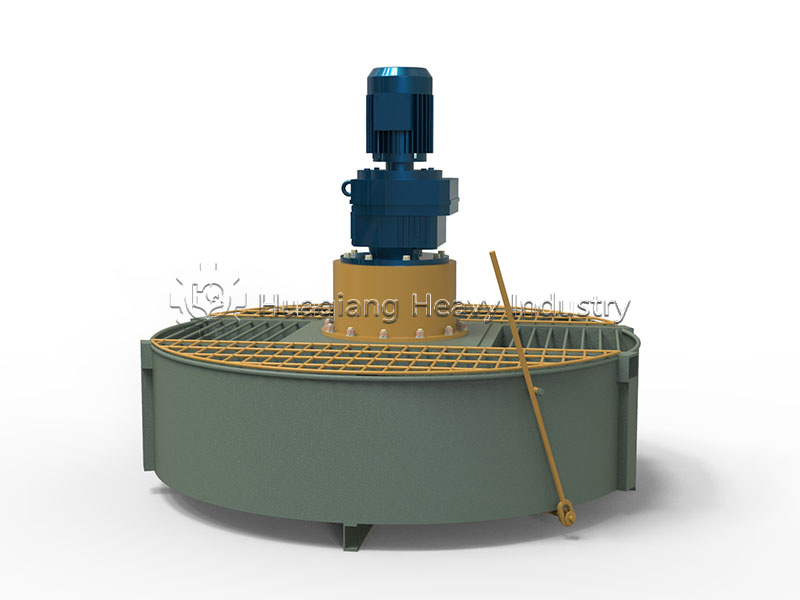
The vertical disc mixer ensures uniform mixing and accommodates a wide range of fertilizer raw materials; it operates stably, offers rapid discharge, and allows for easy maintenance.
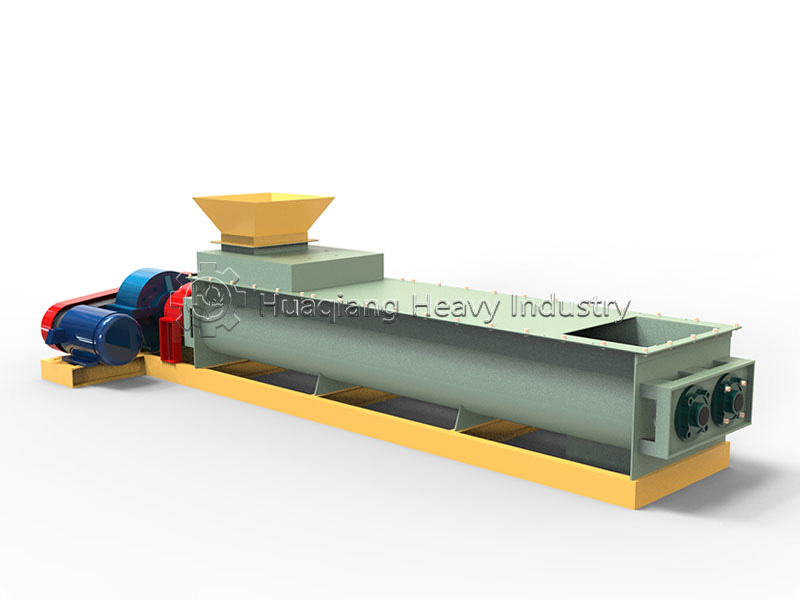
The double shaft paddle mixer is equipped with two rotating shafts; the paddles vigorously turn and blend the materials to ensure a uniform mix, and the machine is commonly used for the pre-treatment of organic and compound fertilizer powders.
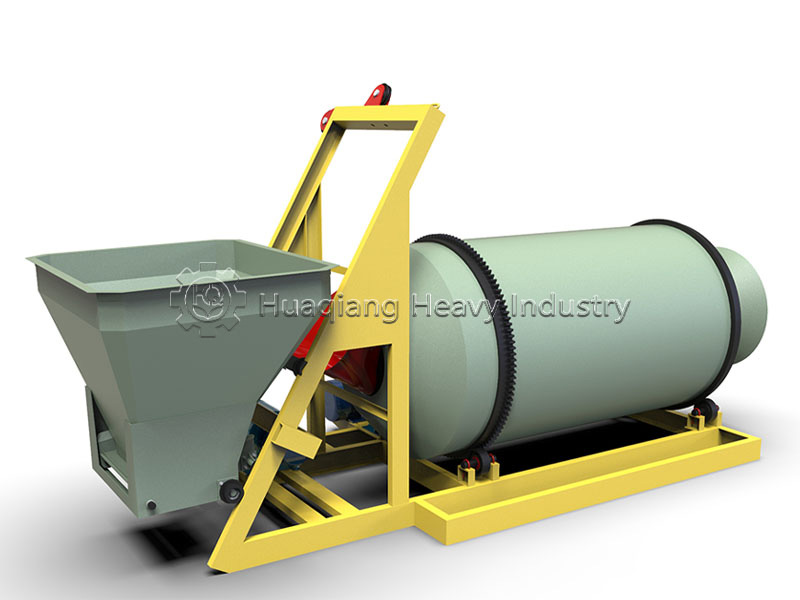
BB fertilizer mixer: ensures uniform mixing with low energy consumption, accommodates various granular fertilizers, and is easy to operate.